Home › Job codes › Army › 120A Construction Engineering Technician
Army 120A · Construction Engineering Technician
In the Army, you spoke a specific language, and it's the one you know. Civilian hiring managers don't speak it. We bridge that gap for you.
Build My Resume $19 one-time · finished in minutes
Construction Engineering Technician (120A) is an Army warrant officer specialty. O*NET's military crosswalk links it to 43 civilian occupations; the closest matches here are First-Line Supervisors of Mechanics, Installers, and Repairers, Construction Managers, and Architectural and Engineering Managers. Typical national pay across these matches runs from $47,120 to $171,270 a year, and 4 of them carry an O*NET Bright Outlook (growing or many openings).

Copy from your OERs or just type what you did as a Construction Engineering Technician Soldier, plus any real numbers.
We translate everything into civilian language and build the whole resume. Nothing invented.
Get 7 polished styles in Word and PDF, your LinkedIn Starter Kit (new to LinkedIn?), and your Career Match Report. Ready to send.
Preview of your Career Match Report
Your $19 package includes a personal Career Match Report built from your own duties. Here are the jobs the U.S. Department of Labor matches to 120A, with typical national pay.
$79,860/yr typical pay
Steady demand
$114,990/yr typical pay
Growing fast
$171,270/yr typical pay
Growing
$79,920/yr typical pay
Growing
$47,120/yr typical pay
Growing fast
Typical pay = national median from the U.S. Bureau of Labor Statistics. Pay varies by location and experience. Job matches from the O*NET Military Crosswalk.
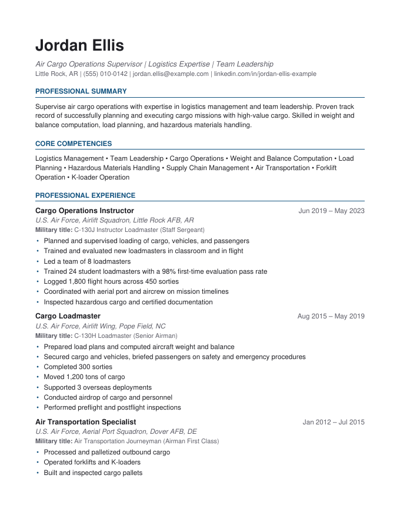
Sample resume lines built from the tasks the U.S. Department of Labor (O*NET) lists for civilian jobs that match 120A. Use the ones that describe what you actually did.
Examples only, adapted from O*NET task statements for First-Line Supervisors of Mechanics, Installers, and Repairers and Construction Managers. Your resume is written from your own duties and uses only the numbers you give us.
Also in your Career Match Report
Most employers use resume-screening software (an ATS, or applicant tracking system) that searches for job-related words before a person ever reads your resume. We work the right ones in for you, using only what you actually did. Your report also lists them for your LinkedIn profile.
CoordinationJudgment and Decision MakingTime ManagementManagement of Personnel ResourcesComplex Problem SolvingAutodesk AutoCADAdministration and ManagementMicrosoft AccessYardi softwareMechanicalBuilding and ConstructionAutodesk AutoCAD Civil 3DQuality Control AnalysisCustomer and Personal Service
I served on active duty in the U.S. Air Force from 2001 to 2009 as a 2W0 Munitions Systems specialist and a C-130 Loadmaster. I served in the Air Force, not the Army, so this page is built from O*NET and BLS data rather than my own memories. The problem is the same in every branch: your experience is valuable, and it has to be written in the civilian employer's language.
Travis Loso, founder of DutyToResume
Lead with a civilian job title that fits what you actually did (the matches on this page, like first-line supervisors of mechanics, installers, and repairers, are a good place to start), and add a secondary line like 'Military title: Construction Engineering Technician (120A), U.S. Army'. Recruiters search civilian titles; the code helps veteran-focused employers.
O*NET maps 120A to 43 related civilian occupations. The closest matches include first-line supervisors of mechanics, installers, and repairers, construction managers, and architectural and engineering managers.
Of the matches on this page, Architectural and Engineering Managers has the highest national median pay: $171,270 a year (BLS 2025). Pay varies by location and experience.
Get a finished, recruiter-ready resume in minutes. $19, one time.
Build My ResumeLast updated 2026-10-15. Sources: O*NET OnLine Military Crosswalk (O*NET 31.0), https://www.onetonline.org/crosswalk/MOC; U.S. Bureau of Labor Statistics 2025 wage data and 2024-2034 employment projections, as published on O*NET OnLine occupation summaries.